Reading Onion Through the Kharif Handover: An ONION Briefing on ₹4,700 at Lasalgaon and a Retail Price Up 116 Per Cent
This briefing reads the onion market in five parts, and the parts spell the crop: ONION. The market is mid-handover. The stored summer crop that carried India through the autumn is running down in quality, the kharif crop that replaces it arrived late and is still arriving in small lots, and the retail price — up more than double on last year — has pulled the vegetable back into the inflation print and within sight of the policy desk. What happens in the next four weeks of arrivals decides whether this stays a firm market or becomes an intervention.
O — October's print: the number that invites policy
The statistics ministry's release of 12 November put consumer price inflation for October at 6.09 per cent, above the Reserve Bank's 6 per cent upper limit, with food inflation at 8.94 per cent. Inside that print, onion stood apart: its retail price was 116.22 per cent higher than a year earlier, worse than September's 108.13 per cent, in a month when potato was 14.24 per cent cheaper than last year. Read that carefully. This is not a general vegetable shortage; it is one storable bulb, priced off a thin transition market, carrying an outsized weight in the basket and in the headlines. Onion has no support price and no procurement programme behind it. When its retail inflation runs above 100 per cent with the headline rate already through the band, the instruments governments reach for are stock limits, buffer releases and export curbs — and every trader holding stock is holding policy risk alongside price risk.
N — New crop at Lasalgaon: a season high on thin arrivals
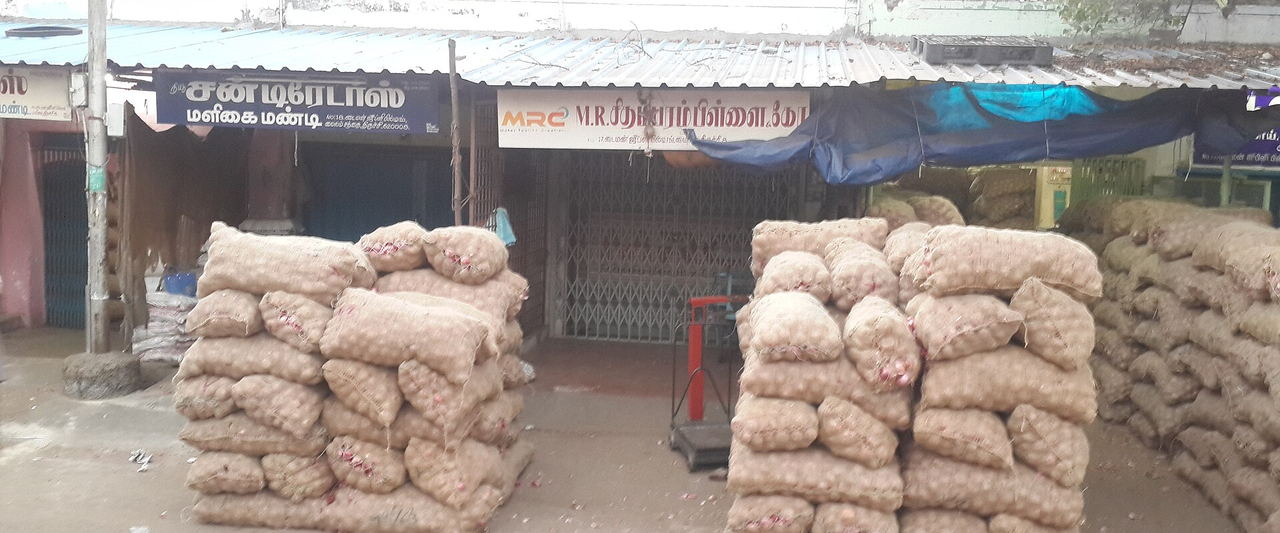
The physical market reopened after Diwali at Lasalgaon, the Nashik market that sets the tone for the country, and its first full session showed how little slack there is. On 13 November, after an eight-day break, new-crop red onion averaged ₹4,700 a quintal, selling between ₹2,500 and ₹5,400, with the top rate the highest of the season so far. Old summer onion from storage averaged ₹3,700. Arrivals were modest: about 140 vehicles in the morning session, 61 of them carrying new red onion from Nashik, Ahilyanagar and Chhatrapati Sambhajinagar districts. The kharif crop is arriving later than usual after a dry sowing period, which is why a reopening auction in mid-November is still setting season highs instead of easing. New crop is not yet a volume story. It is a price story.
| Lasalgaon auction, 13 Nov 2026 | Average (₹/quintal) | Range (₹/quintal) |
|---|---|---|
| New-crop red onion | 4,700 | 2,500–5,400 |
| Old summer onion (stored) | 3,700 | 1,500–4,311 |
Lasalgaon APMC auction, 13 November 2026; about 140 vehicles arrived, 61 with new red onion. Onion has no MSP. Source: market report of the 13 November auctions, in AgricultureIndustry.in weekly, 9–15 November 2026. Table: Farmioc.
The ₹1,000 gap between the two rows — new crop about 27 per cent above stored, by simple division — is the market paying for freshness and shelf life. That premium is rational, and it is also fragile: it lasts only until kharif arrivals build enough weight to compete with each other.
I — Inventory: the stored crop is two different markets
Headline arrivals flatter the supply position, because the stored half of the market is splitting by quality. Trade reporting through November describes old rabi and summer lots as mixed: some still firm with good skin cover, others showing loose skins, sprouting and storage defects after months in the chawls. The share of genuinely export-suitable bulbs inside total arrivals is lower than the mandi totals suggest. The new crop has the opposite problem — sound bulbs that are not ready. Fresh kharif onions need curing and drying before they develop the skin and neck dryness a long sea voyage demands, so a lorry counted at the mandi gate is not yet a container that can sail. Size tells the same story: trade flows concentrate in the 45–65 mm band, with reasonable availability at 45–60 mm and thinner supply above it. Anyone pricing supply off arrival counts alone is overstating what can actually move.
O — Outward: the premium buyers are paying anyway
Export demand has not blinked. Premium Nashik quotations rose from about US$0.53 a kilo in October to about US$0.58/kg in November — roughly 9 per cent in a month, on the Commodity Board's market reporting — and held near that level through 10–13 November. Set against March, when the same premium grade traded near US$0.096/kg in March, the recovery is more than fivefold. Buyers in Malaysia, the UAE and Bangladesh are still taking Indian lots, but they are price-sensitive and they have an alternative: Egyptian fresh onions firmed only slightly, to EUR 0.97/kg FOB. Processed product shows the tightness arriving more slowly — white onion powder held at EUR 1.63 a kilo FOB New Delhi while grade-B powder and organic flakes each edged up two cents — which is why dehydrators can still extend coverage before fresh-market tightness feeds fully into ingredient prices.
N — Next: arrivals build, and so does the trigger risk
Two clocks now run against each other. The supply clock is reassuring: kharif arrivals from Maharashtra and Karnataka should build through late November and December, government officials continue to signal a broadly comfortable national supply position, and every additional week of arrivals presses on that ₹4,700 average. The policy clock runs the other way. Retail inflation above 100 per cent in a politically sensitive staple, with headline inflation already above the target band, shortens the distance to an intervention — a stock limit, a buffer release, an export condition — each of which would reprice stored and export-grade stock overnight. Export-grade tightness, meanwhile, does not clear with arrivals; it clears with curing, which lags harvest by weeks. So the market can ease in the mandis and stay tight at the port at the same time, and probably will.
The decision
Exporters should stagger shipments and sell the premium while it is paid for quality, not scarcity — document curing, grade hard into the 45–60 mm band, and avoid building a December book that one export notice can strand. Domestic traders holding stored stock should treat the new-crop premium as a countdown: the 27 per cent gap over old-crop prices closes from the arrival side, and stored lots with sprouting risk should move first. Processors and dehydrators have the one genuine window in this market — processed prices have barely moved against a fivefold recovery in fresh premiums — and should extend dried coverage now. PriceHub tracks onion alongside 200+ crops through the season; the two numbers to watch weekly are Lasalgaon's new-crop average and the December retail print, because the first tells you where supply is and the second tells you how much policy risk you are carrying.