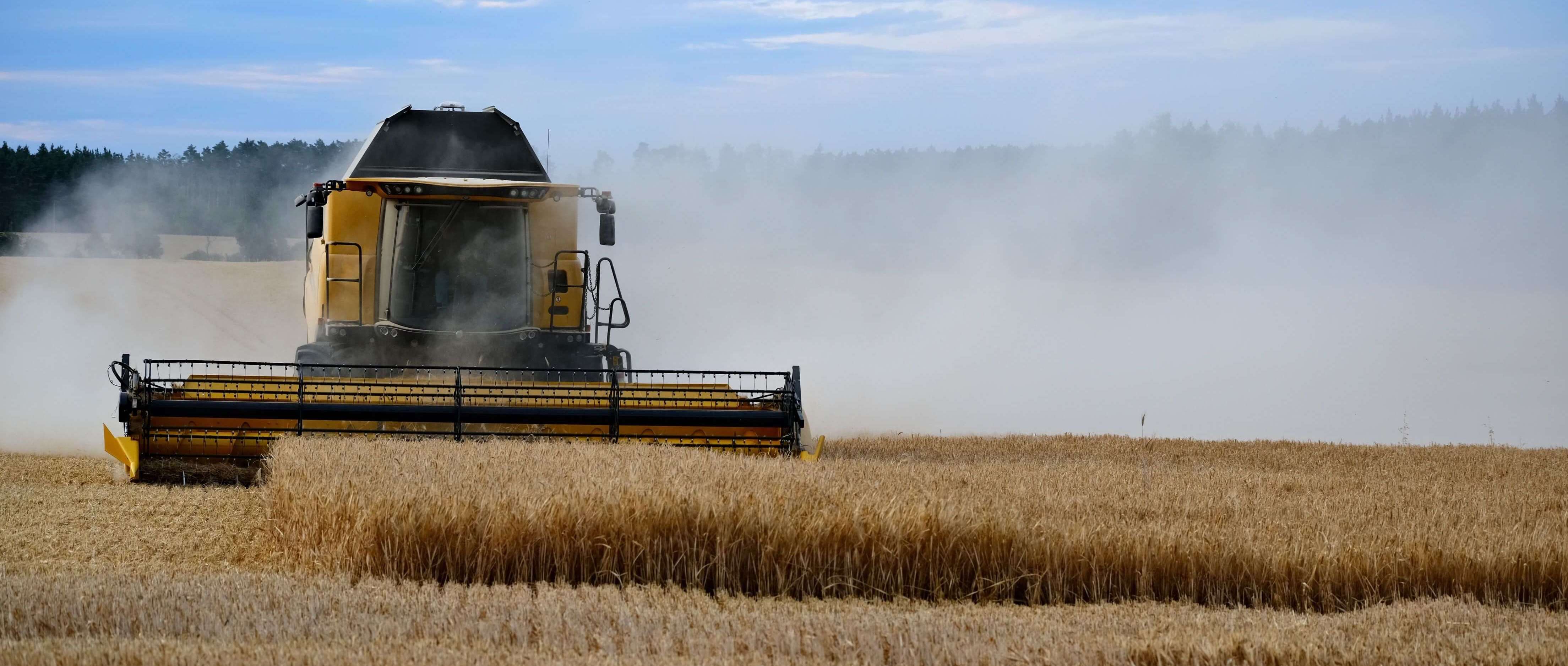
The Information Harvest: Why Data Is Becoming Indian Agriculture's Most Valuable Crop
India feeds 1.4 billion people and a growing share of the world. The next leap in the sector won't come from more land or more labour — it will come from getting the right information to the right people in the value chain, faster than ever before.
Walk into any mandi before dawn and you'll see one of the oldest markets on earth still doing what it has always done: matching what the land produced with what the country needs. What you won't see, in most of those yards, is the one thing that would change the outcome for everyone standing in them — a clear, shared, real-time picture of price and demand. The grain is visible. The information is not.
That gap is the most important story in Indian agriculture today. Not the monsoon, not the minimum support price, not even the next policy headline — but the slow, structural shift from a sector that runs on instinct and word-of-mouth to one that runs on data. For everyone in the value chain, from the farmgate to the food processor, this shift is quietly redrawing where the advantage lies.
A sector too big to run on guesswork
It is easy to underestimate how central agriculture remains to India. Depending on how you count it, the sector contributes somewhere between 15% and 18% of national output, and it still supports close to 46% of the country's workforce — a far higher share of employment than its share of GDP. In an economy increasingly defined by services and manufacturing, agriculture is the sector that touches the most lives.
The scale only grows when you widen the lens beyond the field. Once you fold in the allied businesses — warehousing and cold chains, fertilizers and crop protection, seeds, dairy, fisheries, food processing, equipment, and the vast commodity trade that moves it all — agriculture becomes one of the largest economic ecosystems in the country, with industry estimates putting its trajectory well into the trillions of rupees over the coming decade.
A system this large, employing this many people, cannot afford to keep running on incomplete information. And yet, for most of its participants, it still does.
The paradox of plenty
Here is the paradox at the heart of Indian agriculture. The country is among the world's top producers of milk, pulses, spices, rice, wheat, cotton, sugar and a long list of other commodities. Output, by and large, is not the problem. What is broken is everything that happens after the crop leaves the field.
A farmer in one district often has no reliable way to know what the same produce is fetching two districts over. A trader works off yesterday's rumours and a handful of phone calls. A processor planning procurement is forced to guess at where prices and arrivals are heading. Each link in the chain is making consequential decisions with a partial view — and the cost of that partial view shows up as wasted produce, mistimed sales, thin margins, and prices that swing harder than the underlying supply and demand ever justified.
This is not a failure of effort. It is a failure of information flow. The data exists — it is just scattered, delayed, and locked inside silos that don't talk to each other. The opportunity of the next decade is to connect those silos and turn raw activity into usable intelligence.
The quiet rewiring underneath
The good news is that the foundations are finally being laid. Over the past two years, India has been building what amounts to digital public infrastructure for farming, anchored by the Agri Stack under the Digital Agriculture Mission. The ambition is to do for agriculture what earlier digital rails did for payments and identity: create a common, verified layer of data that everyone can build on.
The progress is real and measurable. By mid-2025, more than seven crore unique Farmer IDs had been generated, with the government targeting roughly nine crore by 2026 and around eleven crore by 2027. Alongside the farmer registry sit two other pillars — geo-referenced village maps and a crop-sown registry — fed by a Digital Crop Survey that has already covered hundreds of districts and hundreds of crores of plots. These IDs are increasingly wired into real services: crop insurance, Kisan Credit Cards, direct benefit transfers, soil health cards, and MSP procurement.
Strip away the acronyms and what's being built is simple but profound: a trustworthy answer to who is growing what, where, and how much. That single layer of ground truth is the precondition for everything else — better credit, better advisory, better insurance, and crucially, better markets.
The layer that's still missing
Foundational data is necessary, but it is not sufficient. Knowing who grew what is not the same as knowing what it should sell for, where the demand is, and when to move it. That is the layer where the value chain actually wins or loses money — and it is the layer that remains the most fragmented.
Price discovery in India is still patchy. Quotes differ from yard to yard, arrivals data lags, and the people who most need a forward view — the trader deciding whether to hold or sell, the FPO negotiating on behalf of its members, the processor locking in procurement — are often the least equipped to get one. The result is an information asymmetry that quietly transfers value away from producers and toward whoever happens to hold the better view of the market.
Closing that gap doesn't require reinventing agriculture. It requires making market intelligence — prices, arrivals, demand signals, commodity outlooks — as accessible and timely as a weather forecast. When that information becomes a shared utility rather than a privilege, the whole chain gets more efficient: less spoilage, fewer distress sales, tighter spreads, and prices that track fundamentals instead of fear.
What this means for the value chain
For businesses operating across Indian agriculture, the strategic takeaway is straightforward. The competitive edge of the next decade will belong less to whoever has the most assets and more to whoever has the clearest, fastest view of the market.
That plays out in practical ways. A trader with real-time price visibility across markets can time movement and arbitrage with confidence instead of guesswork. An FPO with a reliable read on demand can negotiate from strength on behalf of its farmers. A processor that can see where arrivals and prices are heading can plan procurement and protect margins. An input company that understands cropping patterns at the regional level can place its products where they'll actually be used. In each case, the differentiator is the same: better information, sooner.
The road to the rest of the decade
India's agricultural story over the next several years will be written in two parallel threads. The first is the steady build-out of digital public infrastructure — more farmer IDs, deeper crop surveys, richer registries — that gives the sector a common factual backbone. The second, riding on top of it, is the rise of market intelligence: the tools and platforms that translate all that raw data into decisions the value chain can act on.
The producers and businesses that thrive will be the ones who treat information as an input as essential as seed, water, and credit. Because in a sector this large and this consequential, the next great harvest won't only be measured in tonnes. It will be measured in how quickly knowledge moves — and into whose hands.
At Farmioc, that's the conviction behind everything we build: that the agriculture value chain deserves the same quality of market intelligence that every other major industry takes for granted, and that better information leads directly to better decisions — for businesses, for farmers, and for the country they feed.
Have a view on where Indian agriculture is heading, or a data story you'd like us to dig into? We'd love to hear from you.