The Monsoon Ended at 87 Per Cent. The Rabi Risk Sits in the Regional Split.
The southwest monsoon closed its season on 30 September with an all-India total of 759.4 mm, which is 87 per cent of the long period average. IMD ranks it the fourth lowest since 2001 and the thirteenth lowest since 1901. That national figure is the least useful version of the season. A lender or an insurer does not hold an all-India portfolio. They hold districts, and the districts had very different years.
A season that failed in instalments
The monthly pattern explains why early optimism kept getting revised. June delivered 65 per cent of its long period average. July recovered to 101 per cent, and for a few weeks the season looked rescued. August fell back to 84 per cent and September closed at 92 per cent. Sowing decisions made in the July window were reasonable on the day they were made. Some of them were standing in fields that then went five weeks short of rain.
Out of 36 meteorological subdivisions, 18 received normal rainfall, covering 53 per cent of the country's area, while 17 were deficient, covering 42 per cent. One subdivision, Odisha, recorded excess rain. A season in which 42 per cent of the land area is deficient is not a drought year in the headline sense. It is something harder to price: a patchwork, where the bad tail is long and the average conceals it.
The regional split is the risk map
| Region | Jun–Sep 2026 rainfall, % of LPA |
|---|---|
| Central India | 97% |
| Northwest India | 94.1% |
| All-India | 87% |
| South Peninsula | 76% |
| Northeast India | 74% |
Source: IMD end-of-season release, 30 September 2026. Chart: Farmioc.
Central India finished in the normal category at 97 per cent of LPA, and the northwest at 94.1 per cent. The south and the east did not. South Peninsular India recorded 542.0 mm, the fourth lowest since 1901. Rainfall over East and Northeast India together, at 74 per cent of LPA, was the lowest since 1901 — a striking outcome for a region that is normally water-surplus, and one that matters for portfolios that treat the east as naturally hedged. It is not hedged this year.
Reservoirs: comfortable nationally, thin in the south
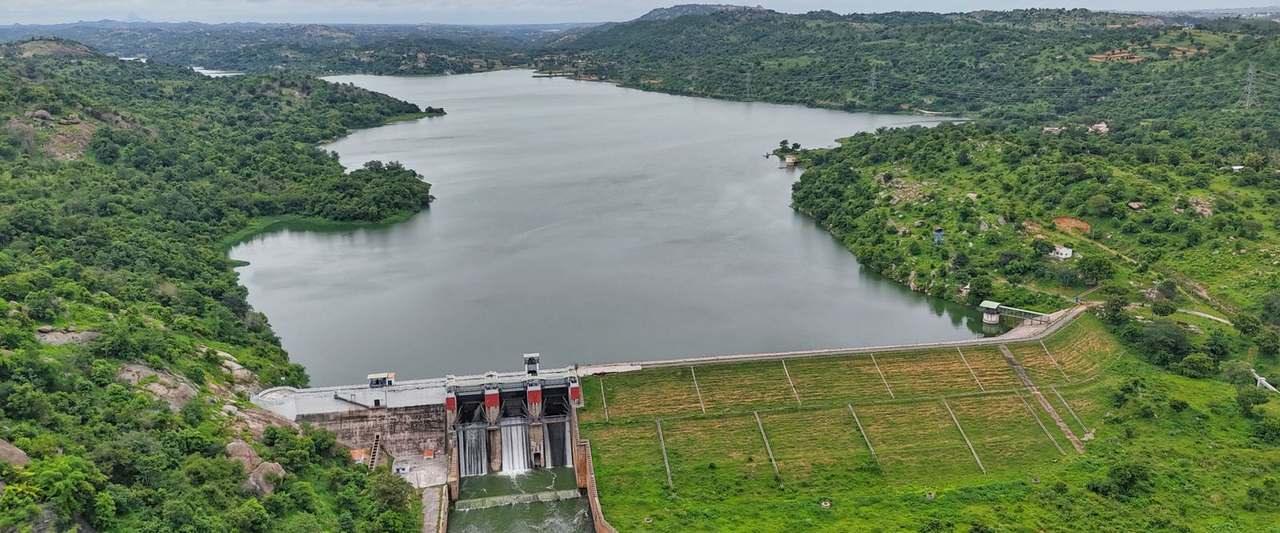
Water in store tells the same story with a lag. In its weekly report this week, the Central Water Commission put storage in 178 major reservoirs at 126.7 BCM, or 68.6 per cent of the 184.8 BCM total capacity. Fifteen reservoirs were full. The southern region, however, was below 45 per cent of capacity, while the western and central regions were above 80 per cent. Aliyar reservoir in Tamil Nadu was reported empty, and storage was low at Mettur, Vaigai and Lower Bhavani in Tamil Nadu, at Somasila and Kandaleru in Andhra Pradesh, at Periyar in Kerala and at Singur in Telangana.
For rabi credit, this is the number that should move first. A reservoir command in the western region enters the sowing season with water for a full crop. A command in the Cauvery or Krishna basins enters it rationing releases against a northeast monsoon that has only just set in. Two borrowers with identical farm economics on paper face different water years. Credit appraisal that prices them the same is working from the national average again, and the national average is the one figure this season has made unreliable.
Insurance: enrolment rose before the losses were counted
The insurance layer expanded in advance of the season, not after it. Under the crop insurance scheme, 241.38 lakh farmers and 278.12 lakh hectares were insured for Kharif 2026 as of 27 August, across 25 states and Union Territories, exceeding the coverage recorded in Kharif 2025, according to the Agriculture Ministry figures carried in PIB's background note. West Bengal re-entered the scheme from this kharif, and Bihar is to implement it again from Rabi 2026-27. The Union Budget for 2026-27 allocated ₹12,200 crore to the programme.
The claims side of that note is the part underwriters should read twice. For Kharif 2025, claims of ₹9,837.61 crore had been paid to 60.89 lakh farmers. This season's claims will be assessed against a yield map drawn by the same patchwork monsoon: normal in the centre, deficient across much of the south and east. Expect the claims to concentrate the same way the rainfall deficit did. A book spread evenly across regions will not perform evenly, and early-warning dashboards should already be flagging the subdivisions IMD counted as deficient.
The outlook offers the south one chance, not a rescue
IMD's outlook, issued with the end-of-season release on 30 September, is a forecast and is labelled as such here. It puts October rainfall for the country as a whole at below normal, under 85 per cent of LPA, with most of the country expected to receive below-normal rain through October–December except parts of the northwest and the southern peninsula. Seasonal rainfall over South Peninsular India for October–December is forecast to be normal, at 88–112 per cent of LPA. October temperatures, maximum and minimum, are expected to be above normal over most of the country. Strong El Niño conditions are prevailing and are forecast to strengthen through the end of the year, with neutral Indian Ocean Dipole conditions likely to continue.
Read plainly: the northeast monsoon is the south's one remaining inflow this water year, and IMD expects it to be normal, not generous. Reservoir managers and rabi lenders in Tamil Nadu, Andhra Pradesh, Karnataka and Telangana should plan on normal and be pleasantly surprised by more, rather than the other way round. Above-normal temperatures through October add an evaporation and soil-moisture cost on top of the storage gap.
What to do with a patchwork season
Price the region, not the country. Move rabi exposure limits, collateral haircuts and insurance monitoring down to subdivision and reservoir-command level. The 87 per cent all-India figure should appear in no credit note written this season.
Watch southern storage weekly, not seasonally. The gap between the southern region at below 45 per cent and the west and centre above 80 per cent will either narrow with the northeast monsoon or harden into the rabi outcome. The Central Water Commission's weekly bulletin is the trigger series.
Align claims readiness with the deficit map. The 17 deficient subdivisions are where Kharif 2026 claims and crop-loan stress will surface first. Staffing and verification capacity belong there, in advance.
Farmioc DataStore organises satellite and ground data — supply, demand, yield and harvest — by crop and region, for users in the financial sector and agribusiness. That regional grain is the point. In a season like this one, the institution that reads the map instead of the average will see its rabi risk months before the institution that does not.
Farmioc is India's agriculture data analytics and agri trading company. Explore DataStore for yield and harvest analytics, or PriceHub for commodity market intelligence across 200+ crops.